



Timeline of Building History
Elisabeth Spring (Unterer Brunnen, Kurbrunnen)
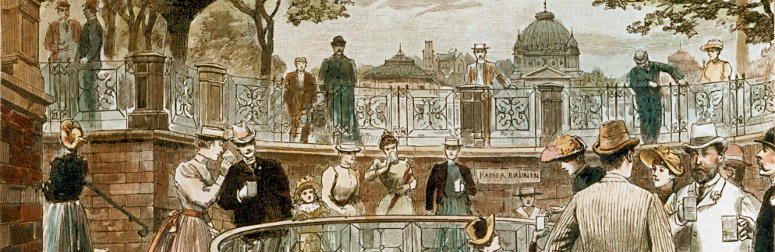
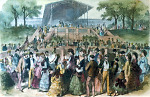
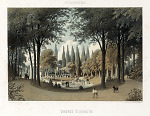
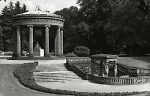
The Elisabethenbrunnen spring, named for the wife of Landgrave Friedrich VI and daughter of English King George III, was considered the most important spring for the spa business in Homburg. The spring was originally used to extract salts and was connected directly to the saltworks. In 1834, medical advisor Dr. Christian Trapp examined its medical properties. After successful applications and water analysis by Justus Liebig in 1836, the previously hard-to-reach spring was tapped. The spring, originally also known as “Drinking Spring”, “Lower Spring” and “Spa Spring”, received its cast-iron pavilion in the late 1850s, which however put pressure on the surface water veins, leading in 1860s to more construction, which included lowering. Around 1870-71, Louis Jacobi built a new neo-Baroque spring catchment wall with stairs, that led up to the promenade in front of the Palmenhaus. In 1916, sculptor Hans Dammann, who also constructed the Durstbrunnen (Thirst Spring), was entrusted with the redesign of the Elisabethenbrunnen spring. He combined the shapes of Greek antiquity and ideas from Emperor Wilhelm II. This developed into an structure crossways to the visual axis of the Brunnenallee Road integrated into the landscape of the park; a style which unfolded with two semicircular staircases on two levels. Across from this is an Ionian monopteros with the goddess Hygeia in the center. Dammann described the construction being carried out during the First World War in his explanatory report about the construction: Therefore, “at the request of his Majesty the Emperor, [...] construction was begun during the war, to provide our brave soldiers and wounded soon the healing power of the completely renovated, impressively designed spring”. The new design around the spring meant that the Palmenhaus and the promenade had to be torn down.
Illustrations (titles and descriptions in German)


Building History
- Construction
- Ende 17. Jahrhundert
- Conversion
- 1834 (wiederentdeckt), 1835-1836, 1857-1858, 1859-1860, 1870-1871, 1912 (neu gefasst)
- New Building
- 1916-1919
Location
Networking
Follow the links below to display similar records from Spa Places.
- Subject Area
- Social and Health
- Funding
- public
- Keywords
- Springs
References
StA HG, A 03, Nr. 395
StA HG, E II, Nr. 55
StA HG, E 41, Nr. 228
Bilder und Dokumente S. 18
Kurpark S. 28-29
Baeumerth, Fremde S. 7, 201-206
Baeumerth, Kennen S. 44-46
Baeumerth, Königsschloß S. 31-33
Brückl, Elisabethenbrunnen
Dölemeyer, Jacobi S. 96
Fechtner, Altes Bad Homburg S. 62
Lingens, Frühgeschichte S. 18-25
Lotz, Geschichte 2 S. 116, 262-263, 306
Rowedder, Denkmaltopographie S. 268-269
Walsh, Trapps S. 71
DenkXweb
Recommended Citation
„Elisabeth Spring (Unterer Brunnen, Kurbrunnen)“, in: Orte der Kur <https://www.lagis-hessen.de/en/odk/record/id/1086> (aufgerufen am 08.09.2026)