


Extended Search
Kurhaus Spa
Early on during the spa business, bathing spa treatments were seen as problematic in that the springs were still far away from the city and the spa locations at that time. People were afraid of a reduction in quality while the water was being transported, because there were no direct pipelines. Nonetheless, there were already four private bathing facilities in 1837. Transportation to a bathhouse in the spring area could not be carried out due to the distance. In 1847, during the expansion of the Kurhaus spa the Kurhaus baths were built and leased by master carpenter Johannes Sauer. In the contract of 1857, the spa company agreed to take over and operate the bathhouse. At that time, the baths offered 48 bathing cabins and facilities for shower baths, rain baths, and steam baths. In 1877-78, peat baths were set up, and in 1901, there was a general renovation and modernization, which allowed the Kurhaus baths also to be used for winter spa treatments, while the Kaiser-Wilhelms-Bad (Emperor Wilhelm Spa) was only available during the summer season. The Kurhaus baths now also had so-called Roman-Irish baths, i.e. steam and hot-air baths, as well as mineral and brine baths. A connection to the Kurhaus spa was also established at that time, to allow for the use of the heated lobby there. From 1934 to 1945, the building housed the “University Institute for Springs and Spas” under the direction of Prof. Dr. Heinrich Lampert, the director of the Institute for Physical Therapy at the University of Frankfurt am Main and simultaneously Head Physician of the Department of Internal Medicine at the District Hospital. The building was torn down at the beginning of the 1950s when the new Kurhaus spa was being built.
Illustrations (titles and descriptions in German)
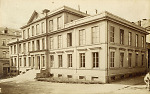


Grundriss mit Einzeichnung der Badewannen um 1861
(Plans, Outlines, Drawings)
Building History
- Construction
- 1847
- Demolition
- Anfang der 1950er Jahre
Location
Networking
Follow the links below to display similar records from Spa Places.
- Subject Area
- Social and Health
- Funding
- public
- Keywords
- Bath houses
References
StA HG, E II 3, d
Baeumerth, Fremde S. 210
Baeumerth, Königsschloß S. 239, 258-259
Der Tourist, 19. Jg., Nr. 14, 15.7.1902
Schick, Führer durch Bad Homburg und seine Umgebungen. Ein Wegweiser für Kurfremde, 1855, S. 24
Recommended Citation
„Kurhaus Spa“, in: Orte der Kur <https://www.lagis-hessen.de/en/odk/record/id/1219> (aufgerufen am 01.10.2026)