



Extended Search
Tramway Depot
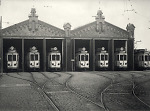
Around the turn of the century, the railway connection to Frankfurt, which had been in existence since 1860, was no longer sufficient for the growing local transportation needs. In 1898, the city and the operator of the electrical plant, the Frankfurt electricity company Lahmeyer, signed a contract for the construction of an electrical street car. Initially, the city was to be connected to the Frankfurt line and then the further Taunus region. The inner-city streetcar network with the last station being the Gotisches Haus (Gothic House) was commissioned in 1899, and the neighboring community Dornholzhausen, which was still independent at that time, was also connected. That same year saw the connection to the municipality of Kirdorf as well as the extension of the line to Saalburg. Also in 1899, a depot made of brick was built on Höhestraße Road to accommodate the streetcars, which was in existence until 1971.
Illustrations (titles and descriptions in German)
Building History
- Construction
- 1899
- Demolition
- 1971
Location
Networking
Follow the links below to display similar records from Spa Places.
References
Bilder und Dokumente S. 106, 125
Baeumerth, Fremde S. 10, 86
Fechtner, Altes Bad Homburg S. 127
Grosche, Geschichte 3 S. 442
Rowedder, Denkmaltopographie S. 124
Söhnlein, 150 Jahre S. 29-65
Söhnlein, Bad Homburg-Frankfurt S. 51, 64-66
Söhnlein, Endstation
Söhnlein/Walsh, Bahn
Walsh, Schornsteine S. 150, 153
DenkXweb
Recommended Citation
„Tramway Depot“, in: Orte der Kur <https://www.lagis-hessen.de/en/odk/record/id/1092> (aufgerufen am 01.10.2026)