



Keywords
Villa Renaissance
The house was built at the beginning of the 20th century in the country-house style of French historicism, a cubic, two-story structure, at the address Am Rondell 2. After the First World War, Margarete Groß from Gollnow, Pomerania, set up a “dietetic spa guesthouse” in the “Villa Renaissance”, which she ran independently under her name. Her husband, a businessman, came from Gleiwitz, Upper Silesia. The guesthouse took long-term tenants as well as spa guests and tourists staying for short time. In 1930-31, the guesthouse offered 14 beds, and in 1933, 20 beds; a room and breakfast cost 2.50 Reichmarks. The house had cold and warm running water, a bath, rooms with a balcony and deck chairs, a garden and central heating. Mrs. Groß offered her spa guests a dietetic regimen based on a physician's instructions. The “Homburg diet” of Dr. Pariser was widely propagated by local spa physicians in the 1920s and 1930s. The Großes belonged to the Protestant church, but their ancestors were Jewish, which is why the couple were subject to the Nazi race laws. After 1939-40, the spa guesthouse no longer appeared as an lodging establishment. The house became a collective lodging for an ever-changing number of Jews who had lost their apartments. All the residents of this “Judenhaus” (Jew House) were deported from Bad Homburg to Frankfurt in the summer of 1942 and then taken to extermination camps from there. Max Groß died in Theresienstadt on 16 October 1943, Margarete Groß in Auschwitz on 31 May 1944. The house in 2015 is still preserved mostly in its original condition; original furnishings and fittings can still be seen in the interior. The building is protected as a historical monument. A fundamental restauration started in 2018.
Illustrations (titles and descriptions in German)
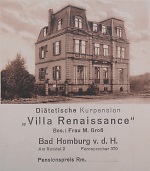
1920er Jahre (Postkartenausschnitt)
(Photographs, contemporary)
Building History
- Construction
- Anfang 20. Jahrhundert
Location
Networking
Follow the links below to display similar records from Spa Places.
References
Rowedder, Denkmaltopographie S. 154.
Peter Lingens: Villa Renaissance: Kurpension und „Judenhaus“. Aus dem Leben von Max und Margarete Groß. In: Unser Homburg 58. Jg., 10/Oktober 2015, S. 5–9.
DenkXweb
Recommended Citation
„Villa Renaissance“, in: Orte der Kur <https://www.lagis-hessen.de/en/odk/record/id/1521> (aufgerufen am 02.10.2026)