



Extended Search
Saalburg
After the Roman fort became the subject of intense scientific research in the middle of the 19th century, the Prussian king and later Emperor Wilhelm I provided funds for restoration for the first time in 1868. Since 1604, the name “Saalburg” has been documented for the Roman fort, which was built in 85 A.D. and expanded in 135 A.D. In 1871, August von Cohausen was appointed a royal conservator of antiquities for the Prussian province of Hesse-Nassau in Wiesbaden, and he was ordered to excavate the fort and secure the existing ruins. Already in 1872, Cohausen suggested rebuilding the site, and to support this endeavor, he founded an association in Homburg. In 1873, to that end a Saalburg museum was set up in the right wing of the Kurhaus spa, which presented the public with the findings that had been made to date. However, influential resistance to reconstruction raised its head, as the idea lacked “any historical starting point”, according to the critics (Grosche, p. 393). In the end, it is thanks to Louis Jacobi that the plan was made reality 25 years later. After he successfully drummed up enthusiasm for the Saalburg in Crown Prince Friedrich and later his son Wilhelm, the latter demonstratively announced the reconstruction of the fort in fall 1897. At the laying of the foundation stone in the fall of 1900, he attended personally with his wife and also visited the construction site on a regular basis in the years following. The rebuilt fort was opened in the summer of 1907.
Illustrations (titles and descriptions in German)
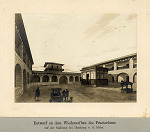

Aufnahme von 1913
(Photographs, contemporary)

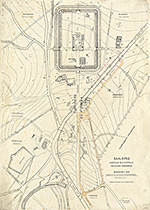
Building History
- Construction
- 85 n. Chr. (80 x 84 m)
- Conversion
- 135 n. Chr. (Erweiterung auf 221 x 147 m)
- New Building
- 1898-1907 (Rekonstruktion)
Location
Networking
Follow the links below to display similar records from Spa Places.
- Subject Area
- Culture
- Funding
- public
- Keywords
- Places of interest
References
Bilder und Dokumente S. 19, 107
Baeumerth, Fremde S. 232
Grosche, Geschichte 3 S. 391-399
Hummel, Wiederaufbau
Obmann/Wirtz, Grundsteinlegung
Rowedder, Denkmaltopographie S. 338-341
Schallmeyer, 100 Jahre
DenkXweb
Recommended Citation
„Saalburg“, in: Orte der Kur <https://www.lagis-hessen.de/en/odk/record/id/1177> (aufgerufen am 01.10.2026)